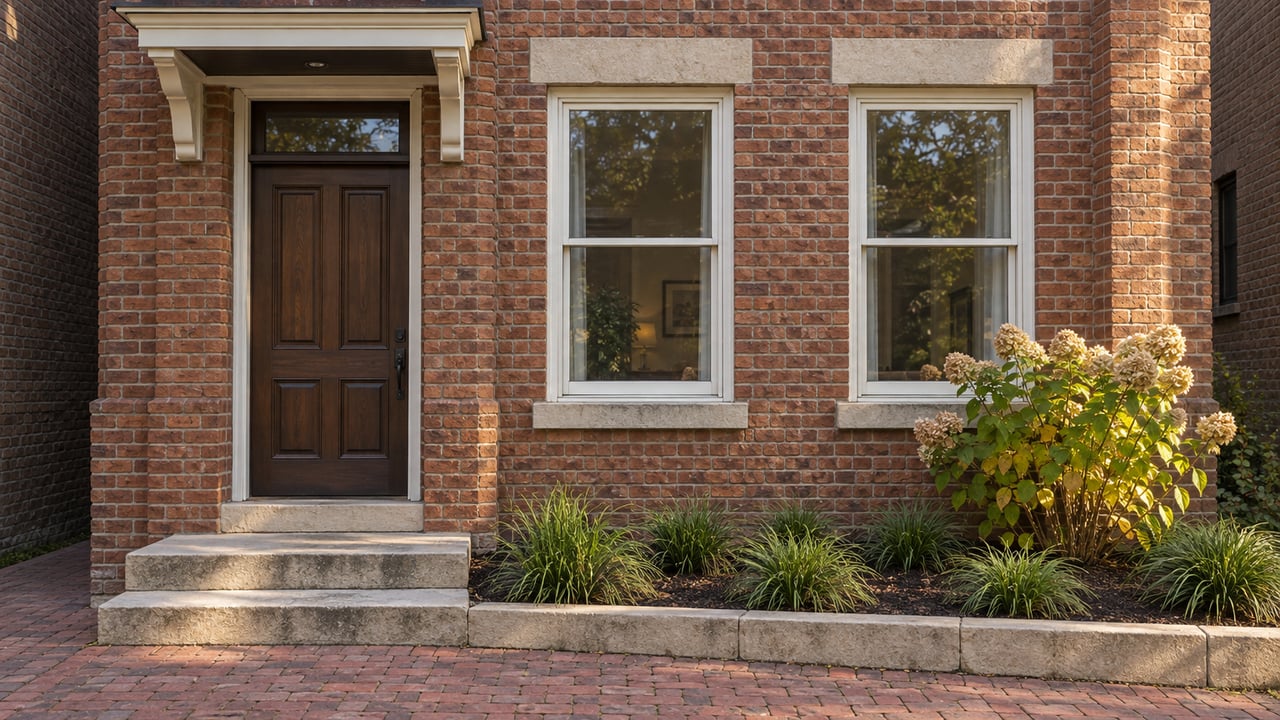
The house at 1945 W. Potomac Avenue was built in 1890 and stands on a corner lot where Potomac meets a north-south side alley, half a block east of the Route 50 bus stops on Damen. According to Chicago YIMBY's August 10 report, developer EZMB LLC bought it in January for $755,000. A demolition permit was issued May 13, and on July 7 the city issued a permit for a three-story building with a basement and two dwelling units. Those units are likely to be a duplex-down and a duplex-up sold as condos.
The city's own address list shows something the permit story leaves out. On the odd-numbered side of W. Potomac, the Wicker Park Landmark District covers 1947 through 2159. On the even side it covers 1942 through 2158. By that list, 1945 is the last odd address outside the district on the block. The houses next door and directly across the street are inside it.
For a buyer, this means you can't judge what can happen to a vintage Wicker Park house by its age, its condition, or its price. Its position relative to the district line decides that, and the line can fall between two neighboring lots.
What the line controls
The Commission on Chicago Landmarks reviews permit applications for alteration, construction, demolition and other work on property inside a designated or proposed landmark district. The Department of Buildings sends those applications to Commission staff as part of the normal permit process. Staff can approve routine work themselves. Under the Commission's pre-permit submission requirements, some categories of work have to go before the full Commission or its Permit Review Committee at a public meeting.
Here is how the features of the 1945 W. Potomac project compare with that list:
| Feature of the 1945 W. Potomac project | Item on the Commission's pre-permit review list |
|---|---|
| Tearing down the 1890 house and detached garage | Demolitions of 40% or more of a building in a landmark district |
| A new three-story-plus-basement, two-unit building | New infill construction projects |
| Rooftop deck, stair enclosure and pergola | Rooftop additions visible from the public way |
| Detached two-car garage with its own roof deck, on a corner lot | Garages on corner properties |
Whether the rooftop elements could be seen from the street, or whether an alley corner counts as a "corner property," would be up to Commission staff. The first two rows need no interpretation. Inside the district, a full demolition and a new infill building would each go to pre-permit review, and the demolition submission has to include a narrative on whether the existing building contributes to the district.
At 1945, the project went through ordinary permitting. Across the street, the city's historic survey data puts an orange-rated building at 1942–1946 W. Potomac, recorded under the 1870s. That building sits both inside the district and on the survey's orange list.
Outside the district, the main historic check is a 90-day hold
Outside a landmark district, Chicago's main historic check on demolition is the Demolition-Delay Ordinance, adopted in 2003. It allows a hold of up to 90 days on a demolition permit for buildings rated red or orange in the Chicago Historic Resources Survey, so the Department of Planning and Development can look at ways to preserve them. Landmark designation is one of those options. The 90 days start when the application reaches the Historic Preservation Division, and the hold can run longer if the applicant agrees.
That ordinance doesn't explain the timeline at 1945. YIMBY reported that EZMB applied to demolish on January 23 and got the permit 110 days later. But a query of the city's red-and-orange survey dataset for 1945 W. Potomac returns no record. The city also notes that the dataset is only a subset of the full survey. The public record doesn't say why the demolition took 110 days, and this post doesn't assume a reason.
The ordinance is in use nearby right now. The city's 2026 demolition-delay hold list shows 2128 N. Damen Avenue in Bucktown, received September 15, 2026, with the status "Under Review." The survey dataset lists that address as orange-rated. It is the only Wicker Park, West Town or Bucktown address on this year's list.
So outside the district, the only historic check is a possible hold of about three months, and only for buildings the survey flagged. Inside the district, demolition, new building and certain visible additions go through public-meeting review against the Commission's guidelines and the federal Secretary of the Interior's Standards.
What a teardown lot costs per unit
The cost of the 1945 W. Potomac project shows why lots outside the line attract builders. Chicago YIMBY has reported five teardown-to-two-unit projects in Wicker Park and Bucktown with purchase prices and permit costs. The construction figures are the estimated or reported costs on the permits, not audited final costs. Soft costs, financing and the developer's margin aren't included.
| Address | Purchase | Reported construction cost | Purchase plus reported costs, per unit |
|---|---|---|---|
| 1945 W. Potomac, Wicker Park (bought January, reported Aug. 2026) | $755,000 | $567,468, plus $20,000 demo | about $671,000 |
| 2229 W. Armitage, Bucktown (bought April, reported June 2026) | $652,500 | $500,000, plus $20,000 demo | about $586,000 |
| 1801/1803 W. Armitage, Bucktown (bought the prior October, reported Jan. 2026) | $525,000 | $609,150, plus $12,250 demo | about $573,000 |
| 2246 W. Lyndale, Bucktown (bought November, reported March 2025) | $645,000 | $725,000 | about $685,000 |
| 2341 W. Belden, Bucktown (bought Dec. 2024) | $650,000 | $620,000 | about $635,000 |
Some details matter when you compare these. At 2341 W. Belden, no demolition permit had been issued when YIMBY reported it, so that teardown wasn't confirmed. At 1801/1803 W. Armitage, YIMBY didn't say whether the units would be sold as condos or rented. Except at Belden, the stories give the purchase month without a year, so the timing comes from when each report ran. The two oldest reports date from early 2025, so those purchases show a pattern but not today's land prices.
The pattern is still clear. In this set, the Potomac lot had the highest purchase price, and developers kept paying $525,000 to $755,000 for an old single-family house to build two units. The house was the cost of getting the lot. These purchases make sense because a builder can expect to demolish and build with no extra review. A lot one address east, inside the district, gives a buyer no such expectation.
Which way the line works for you
The same boundary affects buyers in different ways.
If you're buying a vintage house inside the district, any plan to add a dormer or rooftop addition visible from the street, or to put a garage on a corner lot, goes through pre-permit review. One exception: rear additions no taller and no wider than the existing building, on lots that aren't corners, are excluded from that review list. The same rules apply to your neighbors.
Outside the district, and especially next to an old single-family house on a large or corner lot, the house next door could legally become a three-story, two-unit building with a roof deck, as happened at 1945. The district doesn't limit what you can do with your own lot, and it doesn't limit what happens next door either.
For a builder, the address list shows before you write an offer which lots can be redeveloped through ordinary permitting.
We have covered how condo buildings handle construction projects in Wicker Park and how to plan a gut renovation without derailing a move. A property's district status affects both.
How to check a specific address
- Find the street and address range in the city's Chicago Landmark Address List, and note that even and odd numbers are listed separately. The current version is dated June 9, 2025.
- Treat the designation ordinance as the final authority. The city's landmark-districts map says the legal boundaries are the ones in the ordinances. The Wicker Park District was designated April 12, 1991.
- Search the red-and-orange survey dataset for the exact address, keeping in mind that it covers only part of the full survey.
- Look at the current year's demolition-delay hold list for nearby addresses.
- If you're planning work inside the district, ask Commission staff for an early read. The Commission encourages owners to seek its guidance before filing a permit application.
Frequently Asked Questions
Where does the Wicker Park District begin and end? The Commission's 1989 staff report describes the district as roughly bounded by the Milwaukee Avenue elevated line on the east, Caton Street on the north, and Bell and Leavitt streets on the west. On the south it follows alleys south of Potomac, Damen, Evergreen and Wicker Park avenues. That report's map is labeled as showing proposed boundaries. Check exact addresses against the address list and the ordinance.
Does living inside the district mean every project goes to a public meeting? No. Commission staff can approve work that doesn't need Commission or Permit Review Committee review through the regular permit process. The public-meeting categories are the ones listed above, plus projects staff refer to the Commission.
Is every pre-1940 house outside the district subject to demolition delay? Only buildings rated red or orange in the survey are subject to the 90-day hold. The 1945 W. Potomac address doesn't appear in the city's red-and-orange dataset.
If you're weighing a Wicker Park house near the district line, Marcello Navarro can check its district status, survey rating and nearby permit activity, then turn the result into a realistic plan for what you can build, add or keep. Request a construction-forward consultation and home valuation before you write an offer.
This article is general information, not legal, tax or financial advice. Consult a qualified professional about your situation.