Twenty-five acres. That's roughly what the Chicago Park District controls inside West Loop's borders, spread across five separate properties. For a neighborhood built out of old meatpacking warehouses and loft conversions, with almost no land banked for green space during its industrial decades, that's a thin allotment. And yet if you look at what's actually scheduled on those 25 acres this month, the calendar reads like a much bigger neighborhood's. A birthday party for a dog park. A history museum walking tour. A nine-plot vegetable garden with waiting lists. Fall programming that just opened registration.
The math doesn't explain that gap. The people do. West Loop's outdoor life runs on an unusual density of volunteer boards, park advisory councils, and one entirely donation-funded park, all working small lots harder than the acreage would predict.
What the Neighborhood Actually Has
Five Chicago Park District properties sit inside West Loop's boundaries, and together they add up to about 25.1 acres. Two of them, Union Park and Skinner Park, are full community parks with fieldhouses. Union Park runs 13.46 acres at 1501 W. Randolph St. Skinner Park, at 7.01 acres, sits on the Near West Side and shares its gymnasium and indoor pool with the adjacent Whitney Young High School. Two more, Mary Bartelme Park and Heritage Green, are smaller neighborhood parks built around playgrounds. The fifth is a park the city hasn't gotten around to naming: Park No. 551, a 1.02-acre pocket park at 353 N. Des Plaines St. on the north edge of Fulton Market.
None of that includes the West Loop 569 Bark Park, which isn't a Park District property at all. It's a half-acre, community-run dog park at 1358 W. Monroe St., between Throop and Loomis, operating entirely on donations since 2014. That makes six distinct green spaces functioning as the neighborhood's outdoor infrastructure, only five of which the city technically owns.
Who's Actually Running These Places
Here's where the acreage stops mattering. Mary Bartelme Park's own listing on the Chicago Park District's site is upfront that there's no structured programming happening inside its gates, and points visitors toward classes at Union Park instead. On paper, Bartelme is a passive park. In practice, it isn't, because the Mary Bartelme Park Advisory Council exists specifically to organize events there that the city itself doesn't staff.
The same pattern repeats at Skinner. The Skinner Park Advisory Council, an all-volunteer nonprofit, maintains two of the three gardens on that site, neither of which is run by Park District staff. And the 569 Bark Park doesn't rely on the Park District at all. It's governed by a board of dog owners and funded entirely by donations, which is why its calendar includes things a municipal parks budget wouldn't prioritize, like an annual puppy prom.
It isn't a coincidence that a neighborhood with this little reserved land ended up with this many separate volunteer groups claiming pieces of it. When the acreage is scarce, the organizing has to be dense to compensate.
If you only do one thing on this list, make it the garden circuit. Three separate growing spaces operate within a couple of blocks of each other at Skinner Park, and almost nobody outside the neighborhood knows all three exist.
The Garden Layer Nobody Mentions
Skinner Park alone hosts three gardens with three different origin stories, all within a short walk of each other.
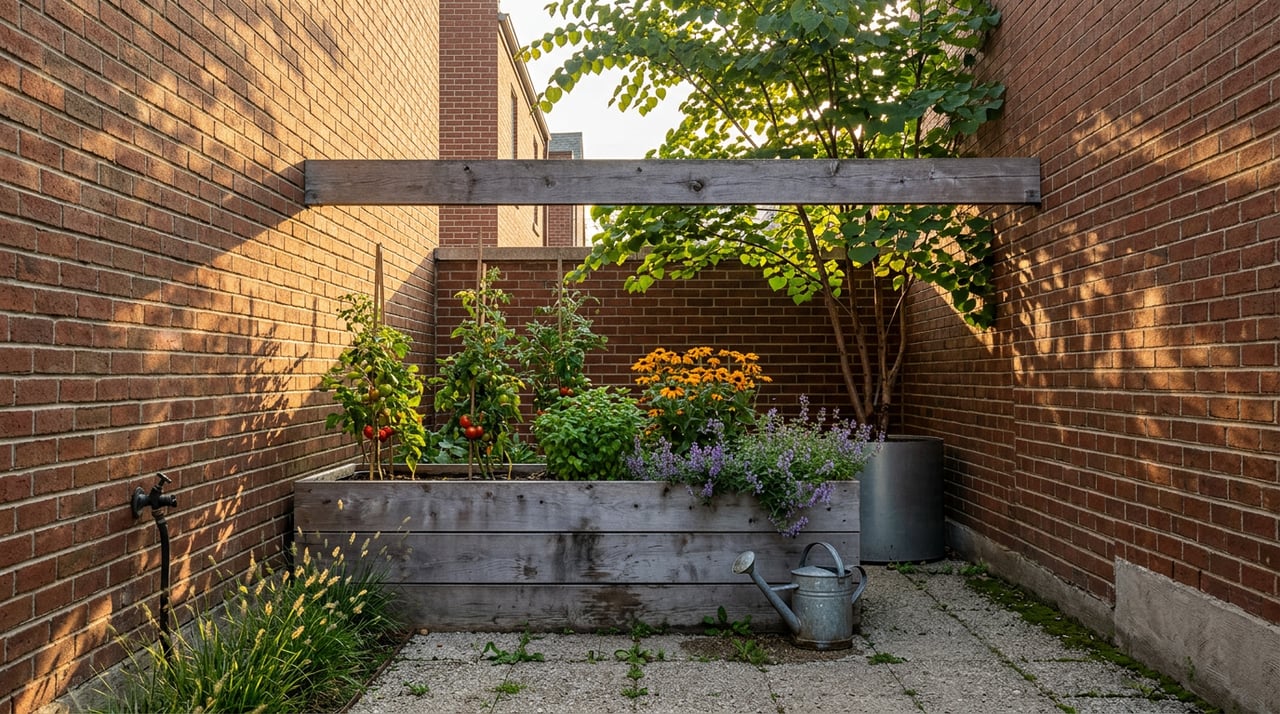
The Community Roots Demonstration Garden is the Park District's own project: nine allotment plots available by application, a $25 seasonal fee plus a liability waiver, and a schedule of free workshops running May through September in partnership with the Illinois Extension Master Gardeners, Green City Market, and the Chicago Botanic Garden. It's a hybrid space, part demonstration beds staffed by the Park District, part community plots tended by residents.
A few hundred feet away sits the Loomis St. Community Garden, which isn't part of Skinner Park at all. It occupies a closed stretch of Loomis Street between Monroe and Adams that the city originally "greened over" for the 1996 Democratic Convention, then let fall into disrepair. The Skinner Park Advisory Council took over its maintenance in 2001 and eventually built out 18 raised allotment plots, including at least one ADA-accessible bed, after construction on Whitney Young's athletic field delayed the project by a year.
The third is the Tranquil Garden, a nearly half-acre ornamental space inside Skinner Park that volunteers began building in 2001 after older residents said there was nowhere in the park designed for them to sit quietly. It was finished in 2005.
Three gardens, three different funding models, three different reasons for existing, all clustered around one park most people would describe in a sentence as "the one with the dog area and the baseball fields."
What's Actually on the Calendar This Fall
None of this is historical trivia. Several of these dates are days away.
| Date | What's happening | Where |
|---|---|---|
| Already open (Aug. 4 online, Aug. 8 in-person) | Registration for Skinner Park's fall session, running Sept. 8 through Dec. 13, 2026 | Skinner Park |
| Sunday, Aug. 16, 2026, 10 a.m. to 1 p.m. | 569 Bark Park's annual birthday party, with raffles, obstacle courses, and caricatures | 1358 W. Monroe St. |
| Saturday, Aug. 22, 2026 | Chicago History Museum walking tour, "Mary Bartelme Park and Beyond," led by local historian Connie Fairbanks | Starts at Adams and Peoria |
| Sunday, Oct. 25, 2026, 10 a.m. to 1 p.m. | 569 Bark Park's Howl-O-Ween costume party | 1358 W. Monroe St. |
The history tour is worth a longer look. It's led by Connie Fairbanks, author of a book on the neighborhood's built history, and covers a mile of sidewalk between Adams and Peoria and Halsted and Madison. Stops reportedly include the building that became Oprah Winfrey's Harpo Studios in 1988, when investors converted a cold storage warehouse on the Near West Side, plus remnants of what was once one of the largest garment districts in the country and the newer Pray for Peace sculpture. Registration includes a week of free admission to the Chicago History Museum itself.
The Judge the Park Is Named For
Mary Bartelme Park opened in 2010 on land the Park District acquired from the University of Illinois four years earlier. It's named for Mary Bartelme, who in 1923 became the first female judge in Illinois and only the second in the country. Born near Fulton and Halsted Streets, she graduated from Northwestern University School of Law in 1894 as the only woman in her class, was appointed Cook County's first woman Public Guardian in 1897, and helped establish one of the nation's first juvenile courts two years later. She went on to found three group homes for girls who came through the court system, including one for African American girls, at a time when almost no comparable resources existed.
The park built in her name leans into the same instinct for making do with limited space. Three diagonal paths cut through one city block to create a fountain plaza, a non-traditional ADA-accessible play area, a sunken dog park with a continuously filling water bowl and artificial turf, and a six-foot viewing hill that clears enough height to see the skyline over the rest of the block. The seat walls in the enclosed garden area are built with salvaged terracotta pulled from the infirmary that used to occupy the site, a small nod to what was there before.
Skinner Park has a longer memory than most people give it credit for. The land was set aside in 1848 by the Illinois and Michigan Canal Trustees, originally called Jefferson Park, and appears in Theodore Dreiser's novel Sister Carrie as a setting. It wasn't renamed for Mark Skinner, a former U.S. attorney for Illinois and one of the city's earliest school inspectors, until 1955.
Why the Small Footprint Works Anyway
None of this changes the underlying fact that West Loop has less park acreage than most Chicago neighborhoods its size. What it has instead is an unusually high concentration of people willing to organize around small lots: a bark park board that funds itself entirely through donations, a park advisory council maintaining two gardens the city doesn't staff, and enough institutional partners, from the Chicago Botanic Garden to Green City Market, showing up to program a nine-plot demonstration garden that would be easy to overlook.
That's the actual mechanism behind West Loop's outdoor life. It isn't the acreage. It's the ratio of organizers to square footage, and right now that ratio is busier than usual, with a bark park birthday this month, a history tour the following weekend, and a full slate of fall garden and fieldhouse programming just opened for registration.
If you're already living in the neighborhood, most of this is worth putting on a calendar. If you're the kind of person who reads a piece like this and starts wondering what a two-flat near Skinner Park or a loft a block from Mary Bartelme would actually cost to buy or renovate, that's a different conversation, and it's one Marcello Navarro has regularly with buyers and owners across the West Loop and the neighborhoods around it. Reach out when you're ready to talk specifics.